
How Multifamily Investors Identify Value-Add Opportunities
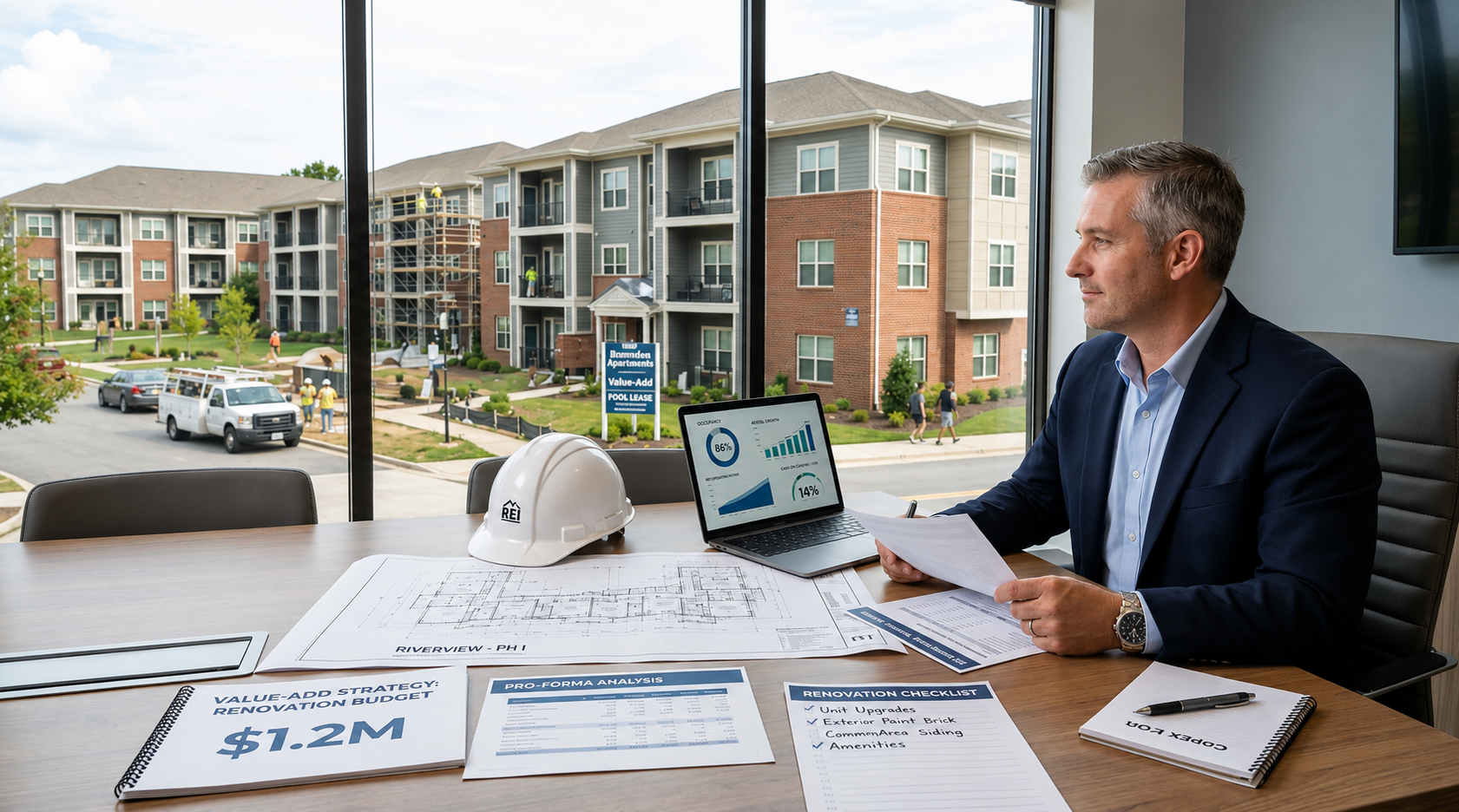
A multifamily property may appear stable while still offering room for stronger performance. The opportunity often lies in identifying where the property is falling short and whether those limitations can be addressed through practical improvements.
For investors, understanding these opportunities means looking beyond the building’s current appearance. Rental income, operating costs, local demand, property condition, and the proposed business plan all matter. Professional operators can help by sourcing properties, testing assumptions, managing improvements, and overseeing performance after acquisition.
What Makes a Multifamily Property a Value-Add Opportunity
A value-add multifamily property has identifiable areas where physical or operational improvements may strengthen performance.
The property may already generate rental income, but below-market rents, outdated units, avoidable vacancies, deferred maintenance, or inefficient management may limit its potential.
Unlike a stabilized property, which generally has consistent occupancy and predictable operations, a value-add property requires active improvement. The goal is not simply to wait for the market to increase the property’s value. Investors expect the business plan to create measurable progress through renovations, better management, improved occupancy, or controlled expenses.
Financial Signs Investors Should Review
The financial records can reveal whether a property is underperforming and whether the proposed improvements are realistic.
Current rental income is an important starting point. Investors should understand how existing rents compare with similar properties in the area and why any gap exists. Lower rents may indicate an opportunity, but they may also reflect poor location, limited demand, or inferior unit quality.
Occupancy trends also matter. Temporary vacancies caused by weak leasing or delayed repairs may be correctable. Long-term vacancy, however, may suggest a broader market or property problem.
Operating expenses should be reviewed as well. High utility bills, frequent repairs, inefficient vendor contracts, or excessive turnover costs may point to areas where performance could improve.
Property Conditions That May Create Potential
Physical improvements are one of the most visible parts of a value-add strategy, but not every outdated feature represents a worthwhile investment.
Older kitchens, bathrooms, flooring, appliances, lighting, and fixtures may make units less competitive. Targeted renovations can improve resident appeal when local renters are willing to pay for the upgrades.
Deferred maintenance may also create an opportunity, although it carries additional risk. Roofing, plumbing, electrical systems, heating equipment, and exterior surfaces can require substantial capital.
Investors should look for a clear scope of work rather than a general promise to improve the property. The proposed renovations should match the building’s condition, local tenant expectations, and the expected rental increase.
Local Market Factors That Support the Strategy
A strong value-add plan must be supported by the surrounding rental market.
Investors should consider population patterns, employment activity, household income, rental demand, vacancy levels, and new apartment construction. Access to jobs, transportation, schools, shopping, and health care may also influence occupancy.
Comparable properties provide useful evidence. Their rents, unit finishes, amenities, occupancy, and leasing incentives can show whether the proposed improvements are appropriate for the area.
A property may have outdated units, but renovations will not automatically create value if renters are unwilling or unable to pay higher rates. Market research helps investors determine whether the opportunity is supported by demand rather than assumptions.
How Improvements May Affect Property Performance
Value-add strategies often combine physical and operational changes.
Physical upgrades may improve unit appeal, reduce maintenance needs, or strengthen the property’s competitive position. Operational improvements may include better leasing procedures, maintenance tracking, rent collection, financial reporting, or tenant communication.
These changes may influence rental income, occupancy, turnover, and operating expenses. Together, they can affect net operating income, which reflects the property’s income after operating costs but before debt payments and certain other expenses.
Investors should understand how each proposed improvement connects to the financial projections. A renovation plan is more credible when the expected cost, rent increase, implementation timeline, and potential impact are clearly explained.
Evaluating the Financial Projections
Projected returns should be reviewed alongside the assumptions used to calculate them.
Investors should consider renovation costs, financing expenses, temporary vacancies, leasing costs, operating reserves, projected rents, and the expected holding period.
The timeline is equally important. If units must be renovated gradually, the property may take time to reach its projected performance. Delays in construction or leasing can affect both income and investor distributions.
A well-prepared plan should also account for less favorable outcomes. Investors may want to see how the investment could perform if renovations cost more, rent increases are smaller, or occupancy improves more slowly than expected.
Conservative assumptions do not remove risk, but they can provide a more realistic view of the opportunity.
Risks Investors Should Consider
Value-add multifamily investments involve execution risk because the expected results depend on future improvements.
Construction costs may rise due to labor shortages, material prices, permit delays, or unexpected property conditions. Renovations may also disrupt tenants and temporarily reduce occupancy.
Market conditions can change during the investment period. Rent growth may slow, insurance costs may increase, financing terms may become less favorable, or new apartment developments may add competition.
Investors should also consider whether the improvement plan depends too heavily on aggressive rent increases or rapid lease-up assumptions.
A strong investment opportunity should explain these risks clearly and describe how the operator plans to manage them.
How Professional Operators Support Investors
Passive investors are not typically responsible for finding properties, managing renovations, handling tenant concerns, or supervising daily operations.
A professional operator can support the investment by sourcing opportunities, reviewing financial records, studying the local market, arranging inspections, and developing the business plan.
After acquisition, the operator may coordinate contractors, oversee property management, monitor expenses, track leasing activity, and report performance to investors.
At Bighorn Capital Fund, this operator-led approach allows accredited investors to participate in multifamily opportunities without taking on the day-to-day responsibilities of property ownership.
The operator’s experience and execution capabilities are therefore as important as the property itself.
Final Thoughts
Identifying a value-add multifamily opportunity requires more than finding an older property or noticing below-market rents.
Investors need to understand the property’s current performance, the local rental market, the proposed improvements, and the risks that could affect execution. Financial projections should also show how the business plan is expected to influence income, expenses, and occupancy.
Professional operators can help by identifying suitable properties and carrying out the strategy after acquisition. For investors, evaluating both the opportunity and the operator can provide a clearer understanding of how value may be created over time.
Frequently Asked Questions
What is a value-add multifamily investment?
It is an apartment property where physical or operational improvements may increase income, reduce expenses, improve occupancy, or strengthen market competitiveness.
Are below-market rents always a value-add opportunity?
No. Investors should confirm that comparable properties support higher rents and that the property can compete after the proposed improvements.
What role does an operator play in a value-add investment?
The operator typically sources the property, develops the business plan, manages improvements, oversees operations, and reports progress to passive investors.
What are the main risks of value-add multifamily investing?
Common risks include renovation overruns, leasing delays, changing market conditions, higher operating costs, tenant disruption, and unrealistic financial assumptions.
How can investors evaluate a value-add opportunity?
Investors can review the market data, renovation plan, financial projections, risk assumptions, operator experience, timeline, and reporting process.